Procuring for participant retention in clinical trials
A practical guide to writing stronger Request For Proposal (RFP) briefs and evaluating retention solutions with participants, caregivers and sites in mind.

Who is this guide for?
Anyone working within a sponsor, biotech or CRO who is involved in planning, procuring or evaluating patient retention support for a clinical trial. It is designed for teams who want to keep the patient and caregiver experience visible throughout study planning, rather than treating retention as something to address only once the study is up and running.
How can it help?
Recruitment rightly receives significant attention: without participants, studies cannot run. But enrolment is only the beginning of the patient journey. Once someone has agreed to take part, the experience of staying in a trial can involve repeated visits, unfamiliar procedures, practical disruption, uncertainty and a significant commitment from patients and caregivers. This is consistent with evidence from people who did not complete trials, which suggests that retention is influenced by how well trial requirements fit with participants’ health, capabilities, expectations and wider lives
We believe retention deserves the same deliberate planning. Avoidable attrition can reduce the completeness and credibility of trial findings and create opportunity costs from resources already invested in recruitment and follow-up. The aim of this guide is not to prescribe one approach. It is to give study teams a practical set of prompts that can help them write clear RFP briefs, compare vendor responses more consistently, and select support that is designed around the needs of the people taking part.
A stronger brief gives vendors the context to propose a stronger solution - and gives study teams clearer criteria against which to evaluate it
The current landscape
Across our industry, considerable effort and funding is invested in identifying and engaging suitable participants through site networks, digital outreach, patient advocacy group relationships and patient databases. Recruitment materials and digital platforms can play an important role in that work.
Once a participant is enrolled, however, the challenge changes. The question becomes: how do we help people understand what is expected, prepare for what comes next, manage practical friction and feel supported throughout what may be a long and demanding study journey?
There are many reasons why participants leave studies, and some - including adverse events or changes in clinical circumstances - cannot and should not be addressed through a retention solution. Other sources of friction may be more amenable to thoughtful support, clear information and timely intervention.

.webp?width=500&height=377&name=Trial%20Flow_Site%20Activation%20Case%20Study_Visual%201%20(1).webp "Research site staff reviewing patient information")
What good retention support can help teams explore
Based on our work with patients and families and existing evidence, we believe retention planning is strongest when it considers the full study journey and asks how support can:
-
Identify likely points of friction before they become barriers to continued participation.
-
Help participants and caregivers understand what to expect, what they need to do, and why it matters.
-
Provide timely, relevant support that reflects the needs of different ages, levels of health literacy, accessibility requirements, and caregiver roles.
-
Give study teams appropriate visibility of engagement and support needs, without creating unnecessary burden for sites.
-
Generate meaningful insight into how support is being used and which content or features are most useful to a particular population.
-
Create appropriate opportunities for participant feedback so that emerging issues can be understood earlier.
At Trial Flow, our team has spent more than 500 hours with patients and families exploring what support they need and when they need it. That work has informed the questions in this guide.
The goal is not retention at any cost. Participants must always be free to withdraw. Good retention support should make participation clearer, more manageable and better supported for those who choose to continue.
From intention to procurement
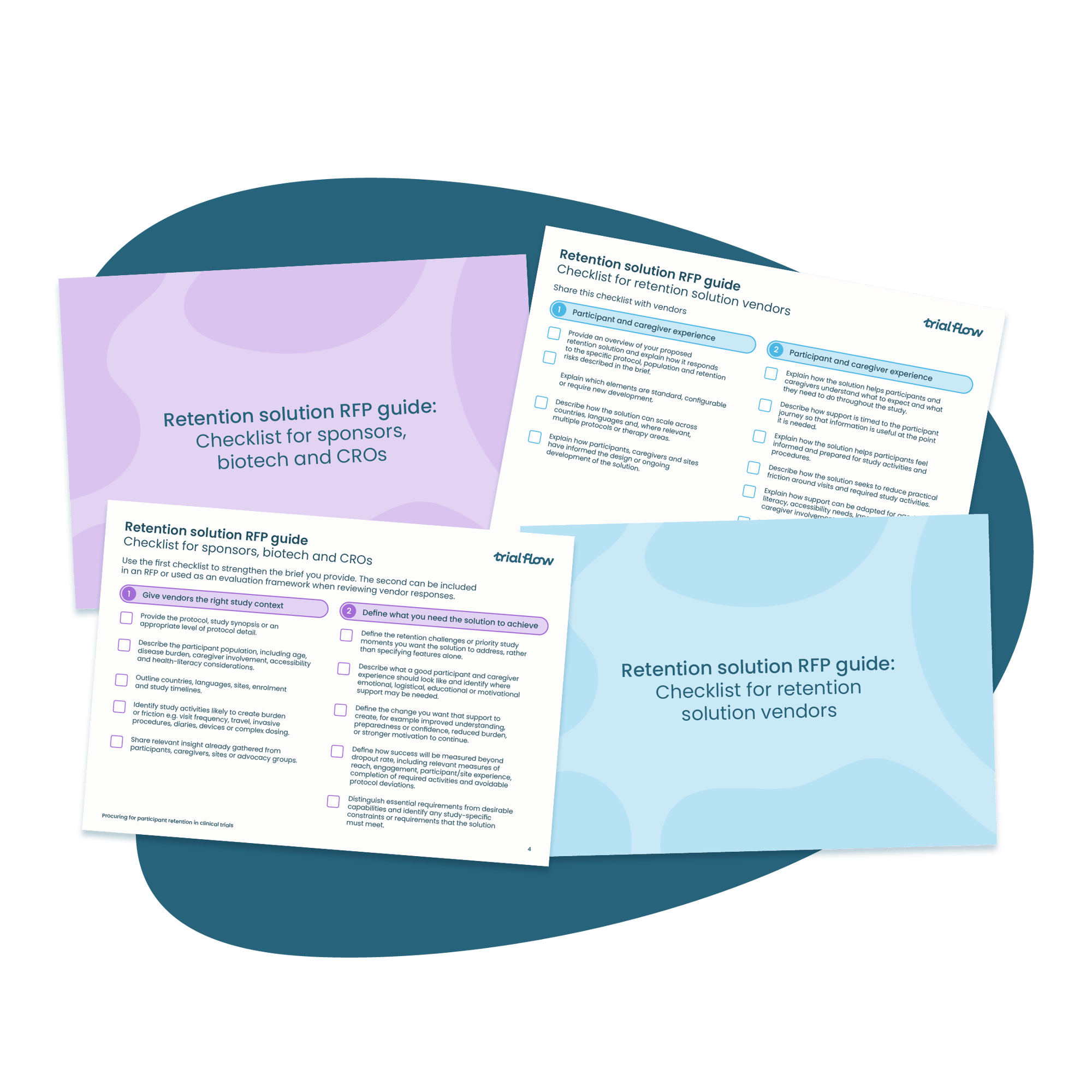
The quality of a retention solution is difficult to judge from a feature list alone. A useful RFP should give vendors enough study context to respond to the real patient journey, while asking for evidence of how their approach will work in practice.
The following checklists are designed to be adapted. Not every question will be relevant to every protocol, population or procurement process. Use the prompts that matter to your study, add protocol-specific requirements and ask vendors to be explicit about what is standard, configurable or dependent on additional services.
Want to discuss your retention brief or the questions you are asking vendors?
Talk to the Trial Flow team today.


.png?width=1500&height=1500&name=Trial%20Flow%20Phone%20(Left).png "Trial Flow Phone (Left)")